Disclosure: we build EasyPusher, so we have a stake in this comparison. Every Pusher figure below comes from pusher.com (the Beams pricing page and Beams documentation), and every Channels alternative is described from its own website, all checked on November 6, 2026. Beams does several things EasyPusher cannot, and we say so where it applies.
Key takeaways
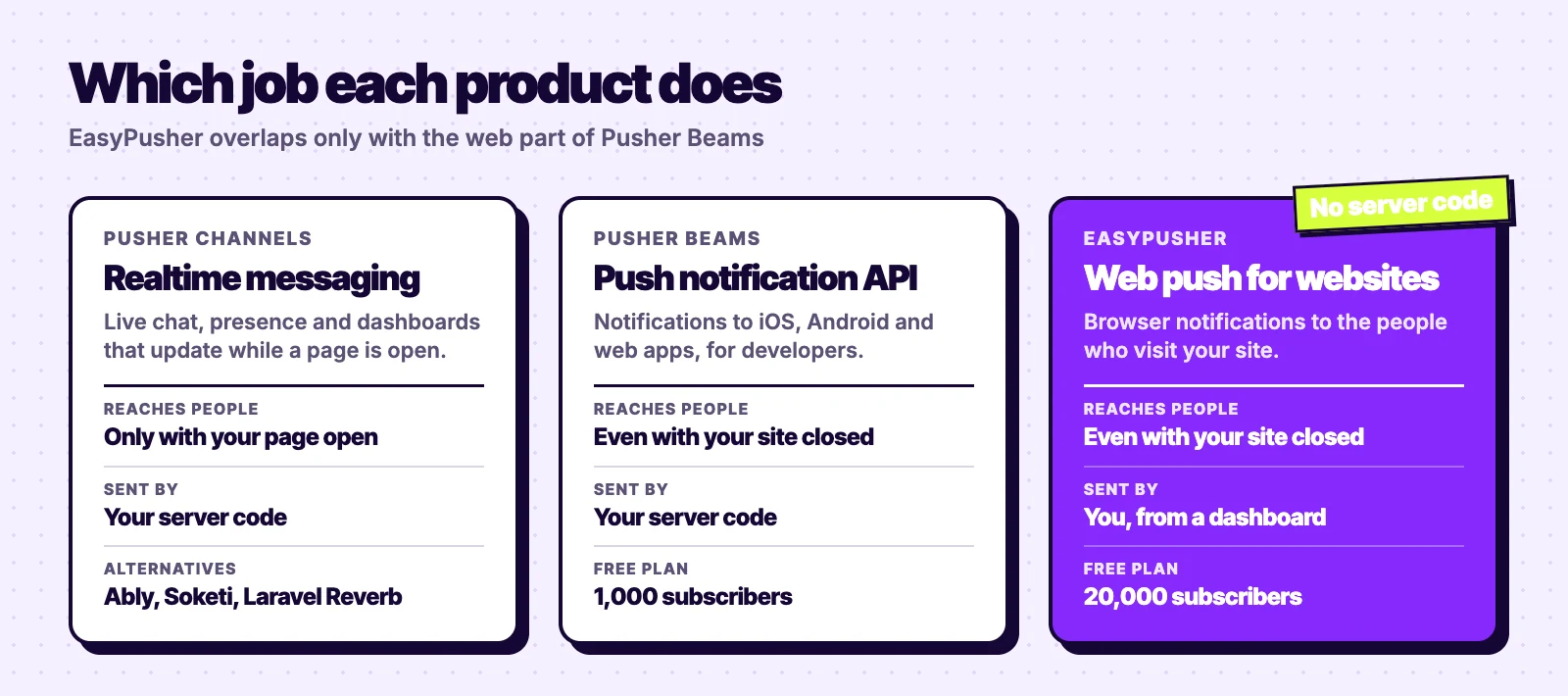
- Pusher sells two products. Channels is realtime messaging inside an open page. Beams is a push notification API. EasyPusher is not a Channels alternative.
- If you need a Channels replacement, look at Ably, Soketi or Laravel Reverb.
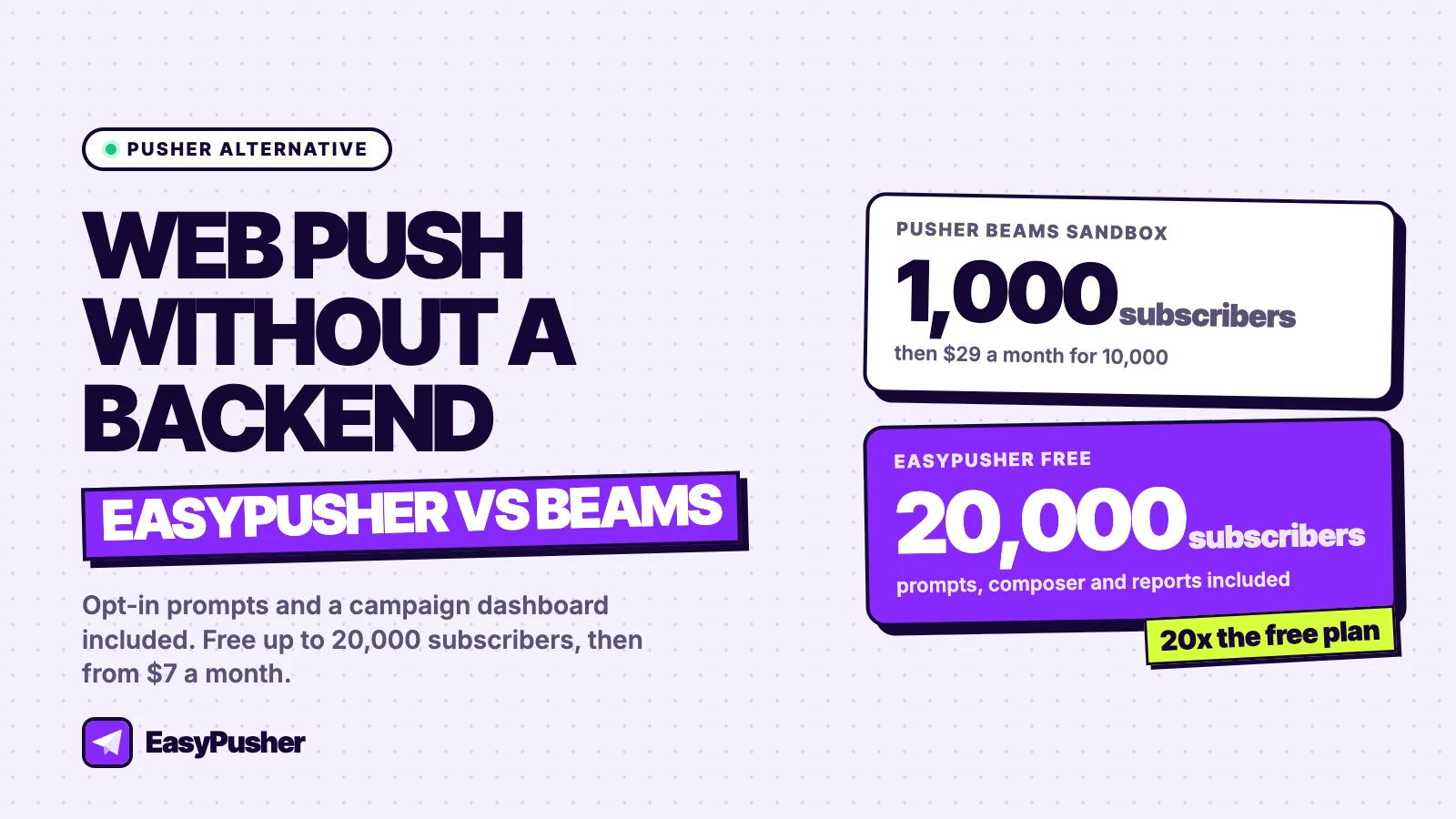
- For browser push to website visitors, Beams' free Sandbox covers 1,000 subscribers and paid plans start at $29 a month for 10,000. EasyPusher is free up to 20,000 subscribers, then from $7 a month.
- Beams is better for mobile app push and for notifications triggered by your own server code. EasyPusher has no public send API; campaigns are sent from its dashboard.
Which Pusher are you looking for an alternative to?
"Pusher" usually means one of two products from the same company, Pusher Limited, which now operates as part of MessageBird. They solve different problems, and the right alternative depends on which one you use.
- Pusher Channels is hosted realtime messaging: publish/subscribe over WebSockets for live chat, presence, dashboards and collaborative features. It only reaches people who have your page or app open.
- Pusher Beams is, in Pusher's words, "an API for sending push notifications to iOS, Android and Web applications". Notifications arrive even when your site is closed.
EasyPusher does one job: browser push notifications for websites. It overlaps with the web part of Beams and with nothing in Channels.
Pusher Channels alternatives for realtime apps
If you came here to replace Channels, these are the options to evaluate. We do not compete with them, so this is a pointer rather than a review.
- Ably is a managed realtime platform with a Pub/Sub product and a free tier. Its documentation describes a Pusher Adapter that lets Pusher client libraries connect to Ably, which can shorten a migration.
- Soketi describes itself as a "Pusher-compatible, open-source WebSockets server" that you host yourself. It is AGPL-licensed, and its GitHub repository was last updated in March 2025, so check its activity before you commit.
- Laravel Reverb is the WebSocket server from the Laravel project. It "utilizes the Pusher protocol", so it works with Laravel Echo and broadcasting, and you can run it yourself or as a managed service on Laravel Cloud.
The rest of this article is about the other use case: sending push notifications to people who visit your website.
What Pusher Beams does well
Beams is a developer tool, and a good one for the job it was built for. It covers iOS, Android, Flutter and web from one API, so an app with mobile and web clients can share one notification system. It has server SDKs for Node.js, PHP, Python, Go, Ruby, Java/Kotlin and Swift, plus REST APIs for publishing, devices and reporting.
You can target device interests (topics a device subscribes to) or authenticated users, where your server links each device to a user ID so you can notify one person on all their devices, up to 100 per platform. That makes Beams a natural fit for transactional notifications such as "your order has shipped" or "you have a new message". Insights adds delivery and open tracking, webhooks and a debug console.
Beams' web SDK is still published: version 1.1.0 is the current stable release on npm, with a 2.1.0 build tagged "next" released in January 2025. We found no deprecation notice on pusher.com.
Pusher Beams pricing vs EasyPusher pricing
| Plan | Pusher Beams | EasyPusher |
|---|---|---|
| Free | Sandbox: 1,000 subscribers | 20,000 subscribers, 200,000 notifications a month |
| Entry plan | Startup: 10,000 subscribers, $29/mo | Starter: 50,000 subscribers, $7/mo |
| Mid plan | Pro: 50,000, $99/mo. Business: 115,000, $199/mo | Growth: 100,000, $19/mo |
| Upper plan | Premium: 250,000, $399/mo | Pro: 200,000, $49/mo. Business: 500,000, $99/mo |
| What is counted | Monthly active devices you sent at least one notification to | Subscribers, plus a monthly sending ceiling |
| Platforms covered | iOS, Android and web | Web only |
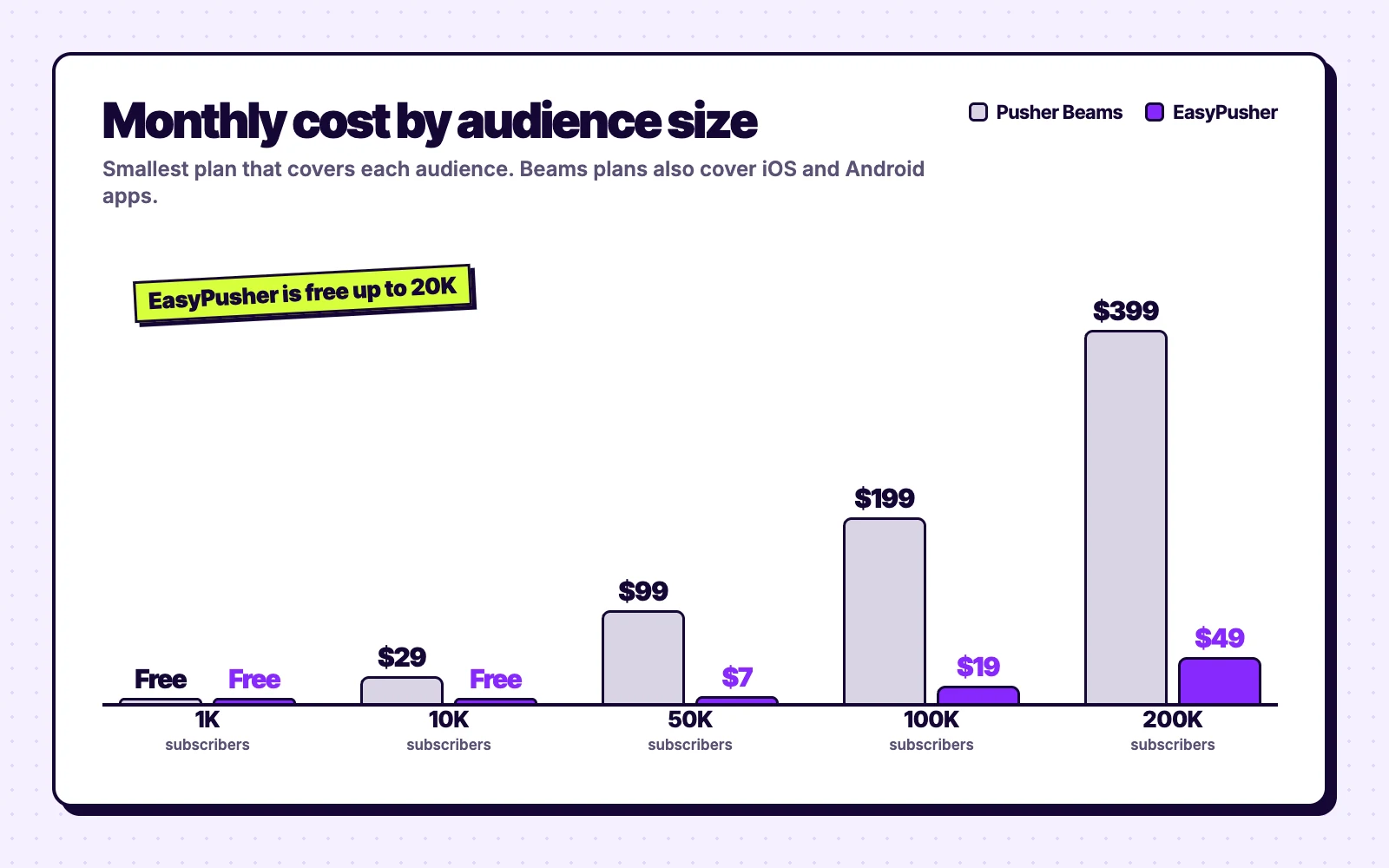
Beams counts a device as billable only if you sent it a notification during the period, while EasyPusher counts subscribers. For a website that notifies its whole list every week, the two numbers end up about the same. The bigger difference is what the price includes: a Beams plan is delivery infrastructure for all your platforms, and an EasyPusher plan is a finished web push product with prompts, a composer and reports, for one site.
Pusher Beams vs EasyPusher for web push: features compared
| Pusher Beams | EasyPusher | |
|---|---|---|
| Sending | From your server, via SDK or Publish API | From the dashboard, now or scheduled |
| Send from your own code | Yes, that is the main way | No public send API |
| Campaign composer | None | Title, message, link, icon and large image |
| Opt-in prompts | You build the UI and call the SDK | Native, soft modal, slide-in and bell, with delay, scroll and exit-intent triggers |
| Targeting | Interests and individual logged-in users | Segments by country, browser or OS |
| Reporting | Delivery and open tracking, webhooks | Sent, delivered, clicked and dismissed, with UTM tags on every link |
| Safari | Needs a paid Apple Developer account and a yearly certificate; desktop only | Standard Web Push with the site's VAPID keys |
| WordPress plugin | None | Official plugin |
| Mobile app push | iOS, Android, Flutter | No |
Setup: what each needs on your site
Pusher Beams
Beams' web quick start has you serve a service-worker.js file at your site root that imports Pusher's worker, load the web SDK from npm or a script tag, create a client with your instance ID, call start() and subscribe the device to an interest. Then you write server code that calls publishToInterests (or the Publish API) whenever you want a notification to go out. Beams does not provide the opt-in prompt, a place to write messages or a subscriber dashboard, so those are yours to build.
Safari takes extra work. Beams' Safari guide requires a paid Apple Developer membership, a Website Push ID and a .p12 certificate uploaded to the Beams dashboard. The certificate expires after a year and must be renewed for the same Website Push ID. The guide also says its Safari web push does not work on iOS or iPadOS, and that Insights do not work in Safari.
EasyPusher
On WordPress, you add your site in the EasyPusher dashboard, install the plugin, paste the API key and pick a prompt style. On any other site with access to the root folder, you add one line of script and upload a two-line ep-sw.js file to the root. Each site gets its own VAPID key pair, generated once and never changed. There is no server code to write: campaigns are composed, targeted and scheduled in the dashboard.
EasyPusher is already in use: one publisher brought back 23,807 visits in 10 weeks from push notifications, and more than 1.68 million notifications have been sent through EasyPusher in total.
How to switch from Pusher Beams to EasyPusher
You cannot export push subscriptions from Beams, but for most visitors you do not need to. Notification permission belongs to your domain, so when a subscriber who already allowed notifications comes back, EasyPusher subscribes them again in the background without a prompt.
- Create a free EasyPusher account, add your site and copy its API key or snippet.
- Remove the Beams web SDK and its service worker, and install EasyPusher in the same release. Only one push service worker can control your site root, so the two should not run together.
- Keep your Beams instance for about 30 days so you can still reach subscribers who have not returned yet. If you also use Beams for a mobile app, keep it for that.
- Expect Safari subscribers to opt in again. Subscribers collected through Beams' certificate-based Safari setup cannot be moved silently.
Our push notification migration guide covers the details.
When Pusher Beams is the better choice
Choose EasyPusher if
- You want browser push for website visitors, not app users
- You want opt-in prompts and a composer without building them
- You want to stay free up to 20,000 subscribers
- You run WordPress, or any site where you can upload a file to the root
Stay with Pusher Beams if
- You need iOS or Android app push alongside web
- Your server code must trigger notifications automatically
- You notify individual logged-in users across their devices
- You need realtime messaging too, and want one vendor for both
Our verdict
If you need a Pusher alternative for realtime messaging, EasyPusher is the wrong product; start with Ably, Soketi or Laravel Reverb. If you need push notifications for an app, or notifications fired by your backend, Beams remains a solid API.
If what you want is to send browser notifications to the people who read your website, Beams leaves you to build the prompts, the composer and the reporting, and charges $29 a month from 10,000 subscribers. EasyPusher includes all of that and is free up to 20,000 subscribers, which makes it the simpler choice for that job.
Frequently asked questions
Is EasyPusher an alternative to Pusher Channels?
No. Pusher Channels is a realtime messaging service for features like live chat and dashboards that update while a page is open. EasyPusher sends browser push notifications to website visitors. If you need a Channels replacement, look at Ably, Soketi or Laravel Reverb.
How much does Pusher Beams cost?
Pusher Beams has a free Sandbox plan for 1,000 subscribers. Paid plans are $29 a month for 10,000 subscribers, $99 for 50,000, $199 for 115,000 and $399 for 250,000, according to its pricing page on November 6, 2026. Billing is based on monthly active devices.
Is Pusher Beams free?
Beams has a free Sandbox plan limited to 1,000 subscribers, counted as unique devices you sent at least one notification to in the last 30 days. EasyPusher's free plan covers 20,000 web push subscribers and 200,000 notifications a month.
Does Pusher Beams support web push?
Yes. Beams supports iOS, Android and web. Its web SDK works in Chrome, Firefox, Edge and Opera, and Safari on desktop needs an Apple Developer membership and a Website Push ID certificate. Beams' Safari guide says its Safari web push does not work on iOS or iPadOS.
Do I need server code to send notifications with Pusher Beams?
Yes. Beams notifications are published from your backend with one of its server SDKs or its Publish API, and Beams has no campaign composer. EasyPusher campaigns are written and scheduled in its dashboard, but EasyPusher has no public send API, so it cannot be triggered from your own code.
Can I move my Pusher Beams web subscribers to EasyPusher?
Push subscriptions cannot be exported, but notification permission belongs to your domain. When a visitor who allowed notifications returns, EasyPusher subscribes them again in the background without a prompt. Remove the Beams SDK and service worker when you install EasyPusher, because only one push service worker can control your site.
Try EasyPusher free
Web push for up to 20,000 subscribers per site, with opt-in prompts and a campaign dashboard included. No credit card required.
Start free