Disclosure: we build EasyPusher, so we have a stake in this article. Every Push Monkey fact below comes from its WordPress.org listings, its own readme, public vulnerability records and archived copies of getpushmonkey.com, checked on November 6, 2026. This article is about Push Monkey, the web push notification service for WordPress, not the toys or games with a similar name.
Key takeaways
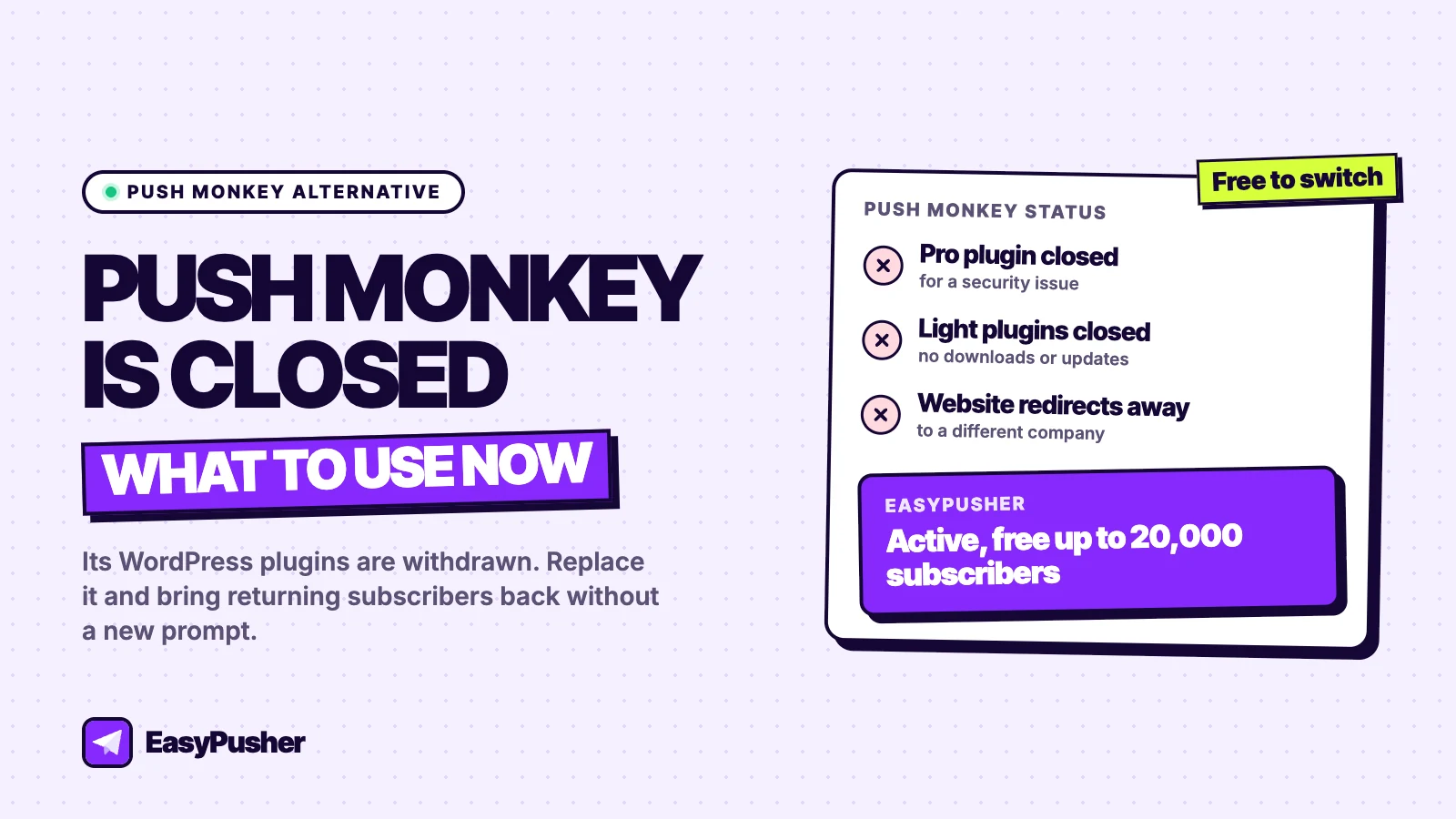
- All three Push Monkey plugins on WordPress.org are closed and can no longer be downloaded. Push Monkey Pro was closed for a security issue.
- Push Monkey Pro was last updated in early 2022 and last tested with WordPress 5.9. getpushmonkey.com now redirects to a different company.
- If Push Monkey is still installed on your site, remove it. Your old subscriber list stays with Push Monkey and cannot be exported.
- Subscribers who allowed notifications on your own HTTPS domain can be re-subscribed silently by a new service when they come back. EasyPusher does this, and is free up to 20,000 subscribers.
What happened to Push Monkey
Push Monkey launched its WordPress plugin in 2014, when browser push was new, and for years it was one of the simplest ways to send notifications from a WordPress site. It connected your site to the Push Monkey cloud service, sent a notification automatically when you published a post, and later added WooCommerce abandoned-cart reminders. Its last homepage described more than 7,500 businesses as customers.
The trail since then is short and consistent:
| What we checked | Status on November 6, 2026 |
|---|---|
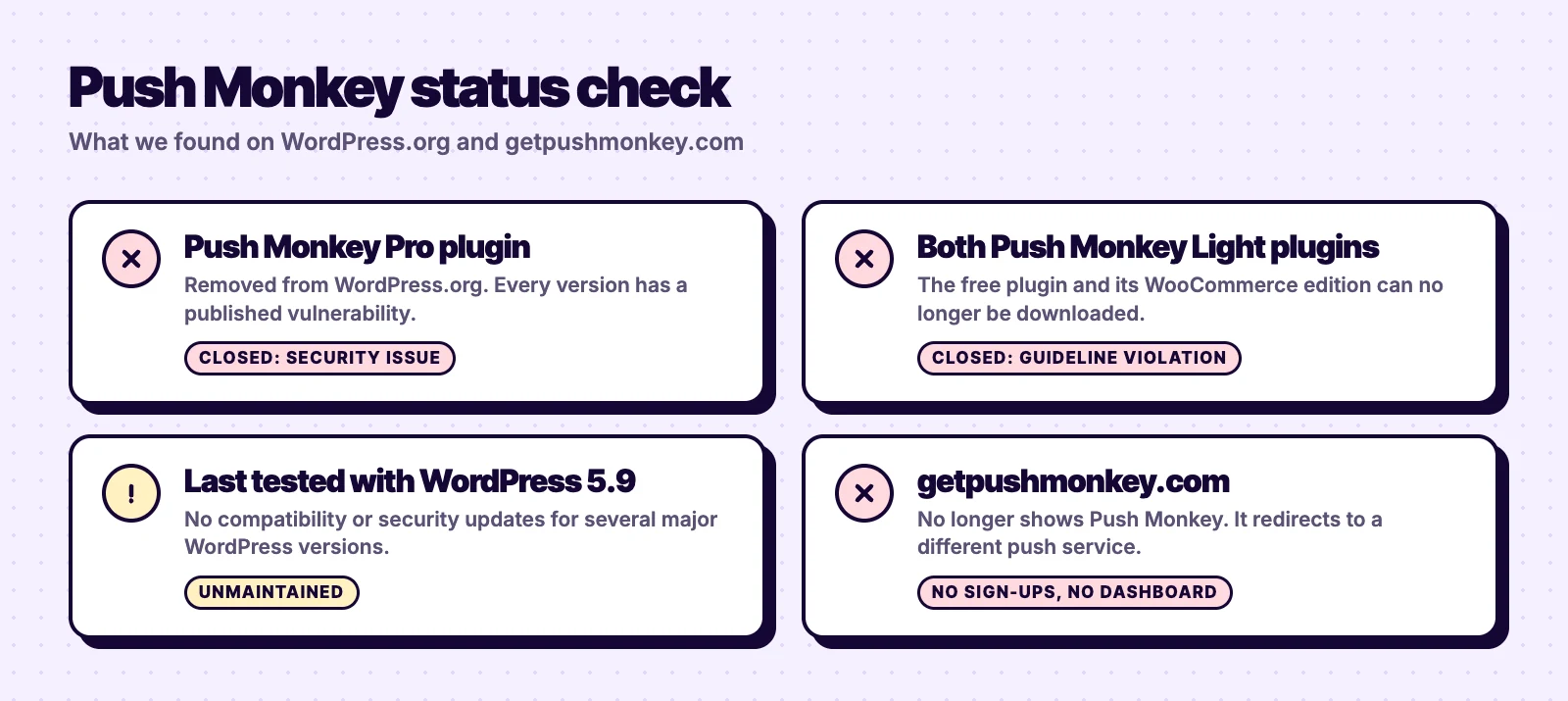
| Push Monkey Pro plugin (WordPress.org) | Closed on November 8, 2024. Reason given: security issue. Last version 3.9, last updated February 2022, tested up to WordPress 5.9. |
| Push Monkey Light plugin | Closed on December 3, 2025 for a guideline violation. Last updated January 2018, tested up to WordPress 4.9. |
| Push Monkey Light for WooCommerce | Closed on December 3, 2025 for a guideline violation. |
| Known vulnerability | CVE-2024-54386: cross-site request forgery leading to stored cross-site scripting, in every version up to 3.9. No fixed version was released. |
| getpushmonkey.com | Last archived as Push Monkey in February 2025. It then showed errors, then unrelated blog posts, and now redirects to chirpyweb.com, a different push service whose site does not mention Push Monkey. |
We found no announcement explaining the closures, no shutdown notice for customers and no new home for the service.
We cannot test a Push Monkey account from outside, so we will not claim the sending servers are switched off. But with the plugins withdrawn, the website gone and the domain pointing at another company, it is not a service you can rely on, and nobody can sign up for it.
If Push Monkey is still on your WordPress site
A closed plugin keeps running on the sites where it is installed. WordPress simply stops offering updates. For Push Monkey that means three problems.
- An unpatched security hole. CVE-2024-54386 lets an attacker who tricks a logged-in administrator into opening a crafted page inject script that is then stored on your site. With no fixed version, the only fix is to remove the plugin.
- Four years without compatibility work. The last release was tested with WordPress 5.9 and still lists PHP 5.6 as its minimum. Every WordPress, PHP and browser change since then is untested.
- Notifications you cannot count on. Even if an old account still sends, it depends on a dashboard and domain that no longer belong to the product you signed up for.
What Push Monkey did, and what to look for in a replacement
Push Monkey's last homepage and readme listed a broad feature set. A fair comparison has to start there, because some of it EasyPusher does not do.
| Feature | Push Monkey (as last advertised) | EasyPusher |
|---|---|---|
| Still available and maintained | No, plugins closed | Yes, plugin updated in 2026 |
| Free plan | Up to 100 subscribers | Up to 20,000 subscribers and 200,000 notifications a month |
| Paid plans | Priced by subscriber count; prices not recoverable | $7 to $99 a month per site, billed monthly |
| Send automatically on publish | Yes, the plugin's default, with category and post type filters | No, campaigns are written in the dashboard |
| RSS to push, drip notifications | Advertised | No |
| WooCommerce abandoned cart | Advertised | No |
| Scheduling and large images | Yes | Yes |
| Segments | Segments and geolocation | Country, browser and operating system, on every plan |
| Reporting | Stats in the WordPress dashboard | Sent, delivered, clicked and dismissed, with UTM tags; stats also in WordPress |
If what you valued most was "publish a post, readers get a notification" with no extra step, look for a plugin with auto-push on publish. Our roundup of WordPress push notification plugins covers several that do, including Webpushr. If you are happy to write each notification yourself, and want a large free allowance and simple pricing, EasyPusher is a good fit.
EasyPusher as a Push Monkey alternative
EasyPusher is a cloud push notification service with an official WordPress plugin. Like Push Monkey, it needs an account: you add your site in the EasyPusher dashboard, paste an API key into the plugin and choose an opt-in prompt.
- A free plan you can stay on. 20,000 subscribers and 200,000 notifications a month, with 30 days of analytics. The only free-plan difference is a small "Powered by EasyPusher" line on the prompt.
- Every feature on every plan. Paid plans raise limits, not features: Starter $7 (50,000 subscribers), Growth $19 (100,000), Pro $49 (200,000) and Business $99 (500,000) a month per site, plus custom Enterprise plans.
- Prompts that fit the page. Native, soft modal, slide-in or bell, shown immediately, after a delay, at a scroll depth or on exit intent.
- A focused composer. Title, message, click URL, icon and optional large image, a segment by country, browser or operating system, then send now or schedule.
- Built to survive caching plugins. The script is about 15 KB, loads asynchronously from Cloudflare's CDN and adds no database queries. The plugin keeps its snippet out of LiteSpeed Cache, WP Rocket and Autoptimize delay and combine features, and restores
ep-sw.jsif the file goes missing. - Little personal data. For each subscriber EasyPusher stores the push endpoint and keys, browser, operating system, country and when they were last seen. No names or email addresses.
How to move from Push Monkey to EasyPusher
Push subscriptions cannot be exported from Push Monkey, and with its website gone there is nowhere to ask. What you still have is the permission itself. Browsers store notification permission against your domain, not against Push Monkey, so a subscriber who allowed notifications on your HTTPS site still has that permission today.
- Remove Push Monkey completely: the plugin, any snippet and any service worker file in your site root. Only one push service worker can control your site.
- Create a free EasyPusher account, add your site, install the EasyPusher plugin and paste the API key.
- Let returning visitors move over. When someone who allowed notifications on your domain comes back, EasyPusher replaces their old subscription in the background, with no prompt.
- Set up a prompt for everyone else, and send your first campaign once the subscriber count starts to climb.
Be realistic about who will not come back this way. Visitors who never return cannot be reached. Subscribers collected on a Push Monkey subdomain, which was how it supported HTTP sites, gave permission to that subdomain rather than your site and must opt in again, as must anyone subscribed through Safari's older Mac-only push system. The usual advice to keep your old account for 30 days does not help much here, since there is no working Push Monkey site to log in to. Our push notification migration guide explains each case.
Choosing your Push Monkey alternative
Choose EasyPusher if
- You want a free plan of up to 20,000 subscribers
- You write and schedule notifications yourself
- You want monthly pricing with every feature included
- You want returning subscribers moved over without a prompt
Choose another plugin if
- You need every new post sent automatically
- You relied on RSS or drip notifications
- You need WooCommerce abandoned-cart reminders
- You also want mobile app push, email or SMS
Our verdict
Push Monkey helped many WordPress sites start with push notifications, but it is no longer a product you can use: its plugins are closed, one for an unpatched security issue, and its website now points to another company. If it is still installed, remove it.
For most blogs and small publishers, EasyPusher is a straightforward replacement: free up to 20,000 subscribers, flat monthly plans after that, and a switch that brings back returning subscribers silently. If automatic notifications for new posts were the whole point of Push Monkey for you, pick a plugin that does that instead.
Frequently asked questions
Is Push Monkey still working?
We found no sign that it is. WordPress.org closed the Push Monkey Pro plugin on November 8, 2024 for a security issue, and closed Push Monkey Light and Push Monkey Light for WooCommerce on December 3, 2025. The getpushmonkey.com website stopped showing Push Monkey in early 2025 and, as of November 6, 2026, redirects to a different push notification company.
Why was the Push Monkey plugin closed?
WordPress.org lists the reason for closing Push Monkey Pro as a security issue. A vulnerability, CVE-2024-54386, affects all versions up to 3.9, the last release. The two Push Monkey Light plugins were closed for a guideline violation.
Should I remove Push Monkey from my WordPress site?
Yes. The plugin has not been updated since early 2022, was last tested with WordPress 5.9, has a published unpatched vulnerability and can no longer be downloaded or updated from WordPress.org. Deactivate and delete it, and remove any Push Monkey snippet or service worker file left on your site.
What is the best Push Monkey alternative?
It depends on how you used it. EasyPusher suits sites that want a free plan of up to 20,000 subscribers and campaigns written and scheduled by hand. If you relied on Push Monkey sending every new post automatically, choose a plugin with auto-push on publish; our roundup of WordPress push notification plugins compares them.
Can I move my Push Monkey subscribers to a new service?
You cannot export them, but you may not lose all of them. Notification permission belongs to your domain, so when a subscriber who allowed notifications on your own HTTPS site returns, EasyPusher re-subscribes them in the background without a prompt. Subscribers collected on a Push Monkey subdomain (its mode for HTTP sites) or through legacy Safari push have to opt in again.
How much does EasyPusher cost compared with Push Monkey?
Push Monkey's last website offered a free plan for up to 100 subscribers; its paid prices are not recoverable from archived copies. EasyPusher is free for up to 20,000 subscribers and 200,000 notifications a month, then $7, $19, $49 or $99 a month per site, with every feature on every plan.
Replace Push Monkey for free
Up to 20,000 subscribers per site with every feature included. No credit card required.
Start free