Disclosure: we build EasyPusher, so we have a stake in this comparison. The Jeeng details below come from Jeeng's own website, its developer documentation, its WordPress.org listing, OpenWeb's website and the original press releases, all checked on November 6, 2026. Jeeng does things EasyPusher does not, and we say so where it applies.
Key takeaways
- Jeeng is the former PowerInbox, renamed in April 2021 and acquired by OpenWeb in January 2023. It still operates, but as "Jeeng, an OpenWeb company".
- Jeeng's homepage now leads with ads for email newsletters. Web push is still listed, but its WordPress plugin was last updated in 2022 and its developer docs cover email only.
- Jeeng Push is priced as a monthly SaaS fee with optional monetisation. No prices are published; you book a demo.
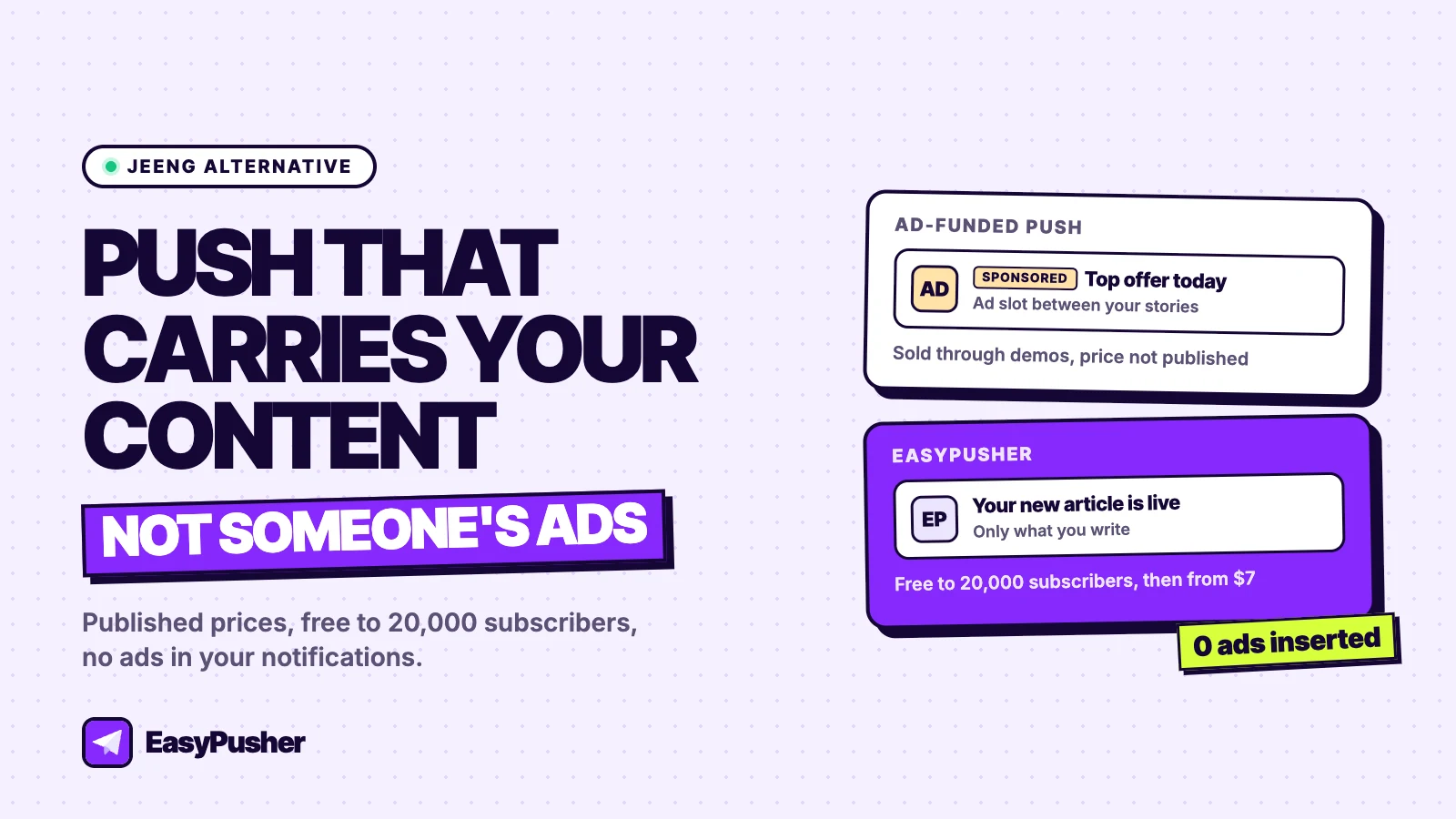
- EasyPusher is a self-serve push service with published prices, a free plan for 20,000 subscribers and no ads in your notifications. It does not monetise your audience or pick content for you.
What is Jeeng today?
Jeeng has changed hands and names more than once, which is why people searching for it are often unsure whether it still exists.
- May 2020: PowerInbox, an email engagement and monetisation company for publishers, acquired a push messaging platform called Jeeng.
- April 2021: PowerInbox renamed itself Jeeng. Its press release described the company as offering "personalized email and browser push messaging and monetization" for publishers.
- January 2023: OpenWeb, the audience engagement company behind publisher comment sections, announced it had acquired Jeeng. The headline put the deal at $100 million, and the release said Jeeng supported more than 650 publishers and 150 million monthly unique visitors.
As of November 2026, jeeng.com is live and branded as an OpenWeb company. Its homepage headline is "Ads for Email Newsletters", and its main products are AdFill (filling unsold newsletter ad slots), AdServe (extending direct-sold campaigns into email) and AdMarket, an advertiser marketplace. OpenWeb's own Jeeng page still lists email, web, newsreaders and web push, behind a "Let's have a conversation" form.
So Jeeng has not shut down, but its centre of gravity has moved to newsletter advertising. Web push looks like a secondary product inside a larger publisher platform.
How Jeeng push notifications work
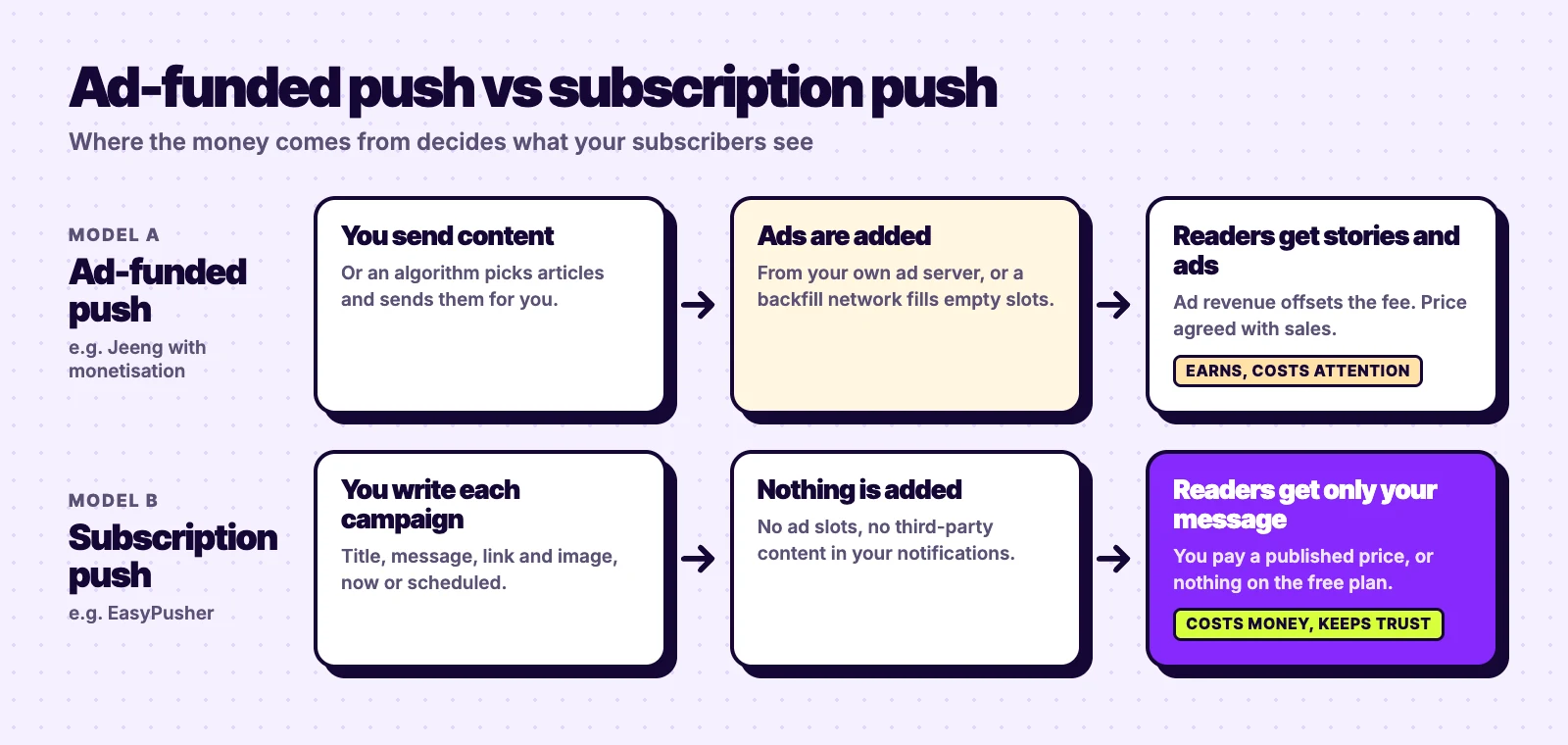
Jeeng Push is built around Jeengage, which Jeeng describes as an algorithm that analyses your content library, builds an interest graph for each reader and then "automatically chooses and sends personalized content to users". Setup is a line of code on your site. You can let it run on its own or configure it by hand.
Monetisation is the other half. Jeeng's AdServe for Push, launched in 2021, lets publishers place ads from their existing Google Ad Manager inventory inside push notifications, and Jeeng said its AdFill service could fill any vacant slots. Jeeng's push page describes pricing as "a monthly SAAS model with an ability to opt in to our monetization services". In other words, ads in your notifications are a choice, not a condition, but the business is designed around offering them.
There is a "Jeeng Push Notifications" plugin on WordPress.org, but it has 10+ active installs, was last updated in November 2022 and was tested only up to WordPress 6.0. WordPress.org warns it may no longer be maintained. Jeeng's developer documentation today covers email ad placements, Google Ad Manager setup and reporting, with no web push section.
Why publishers look for a Jeeng alternative
Uncertainty about the product's future
A plugin untouched since 2022, a homepage about newsletter ads and documentation with no push section are not proof that Jeeng Push is going away, but they are reasons a site owner might want a push tool whose main business is push.
No self-serve plan or public price
Jeeng sells through demos and OpenWeb's partner programme, and OpenWeb notes it works with "a limited number of partners". That suits large media groups. A blog or a small publisher usually wants to sign up, see the price and start the same day.
Ads in a channel readers chose for you
Ad-funded push can pay for itself on a large audience. On a smaller one the ad revenue is modest, and every ad notification spends some of the trust that made a reader click "Allow". Many publishers prefer to keep push for their own content and earn elsewhere.
Jeeng vs EasyPusher compared
| Jeeng | EasyPusher | |
|---|---|---|
| Main focus today | Email newsletter ads, plus email, web and push messaging for publishers | Web push notifications only |
| Pricing | Monthly SaaS fee, not published; book a demo | Published: free, then $7 to $99 a month per site |
| Free plan | None published | 20,000 subscribers, 200,000 notifications a month |
| Ads in notifications | Optional, via your Google Ad Manager inventory or Jeeng's backfill | None. Subscribers see only what you send |
| Who picks the content | Jeengage can choose and send articles automatically | You write and schedule each campaign |
| Email newsletters | Yes, its core business | No |
| WordPress plugin | Last updated 2022, 10+ installs | Maintained, with a Stats page in WordPress |
| Sign-up | Through sales | Self-serve, no credit card |
EasyPusher as a Jeeng alternative
EasyPusher is a cloud push notification service for WordPress and any site where you can upload a file to the root. It does one job, so it is narrower than Jeeng in some ways and simpler in others.
- Published pricing, billed monthly. Free up to 20,000 subscribers and 200,000 notifications a month. Paid plans are $7 (50,000 subscribers), $19 (100,000), $49 (200,000) and $99 (500,000) a month per site, with custom Enterprise plans above that. Every feature is on every plan.
- No ads, no revenue share. EasyPusher does not insert anything into your notifications. You pay for the service, or use the free plan, and your subscribers only hear from you.
- Opt-in prompts: native, soft modal, slide-in or bell, shown immediately, after a delay, at a scroll depth or on exit intent. The free plan shows "Powered by EasyPusher" on the prompt.
- Campaigns: written in the EasyPusher dashboard with a title, message, link, icon and optional large image, sent to everyone or a segment by country, browser or operating system, now or on a schedule.
- Reporting: sent, delivered, clicked and dismissed for each campaign, with UTM tags added to every link so visits show up in your analytics.
- Light on your pages: a script of about 15 KB, loaded asynchronously from Cloudflare's CDN, with no database queries on your front end. The WordPress plugin keeps it out of LiteSpeed Cache, WP Rocket and Autoptimize delay and combine settings.
- Minimal data: for each subscriber EasyPusher stores the push endpoint and keys, browser, operating system, country and when they subscribed and were last seen. No names or email addresses.
What EasyPusher does not do matters as much for a Jeeng user. It has no automatic sending when you publish, no RSS feed, no AI that chooses articles for each reader, no A/B tests, no workflows, no email and no ad monetisation. If you relied on Jeengage to run push for you, EasyPusher means writing your own notifications.
How to switch from Jeeng to EasyPusher
Push subscriptions cannot be exported from Jeeng or any other provider. What carries over is permission: it belongs to your domain, so a subscriber who allowed notifications on your site and comes back is re-subscribed by EasyPusher in the background, without a new prompt.
- Create a free EasyPusher account, add your site and copy its API key.
- Remove Jeeng's code and plugin, then install EasyPusher in the same sitting. Only one push service worker can control your site, so the two cannot run side by side. On a non-WordPress site, add the EasyPusher snippet and upload the two-line ep-sw.js file to your site root.
- Keep your Jeeng account for about 30 days so you can still reach subscribers who have not returned yet, if your agreement allows it.
- Close the Jeeng account once your EasyPusher subscriber count levels off. If ad revenue from push was part of your deal, plan for it to stop.
If Jeeng collected subscribers on one of its own subdomains rather than on your domain, those people have to opt in again, because the permission was given to a different address. Our push notification migration guide explains how to check and what to expect.
When Jeeng is the better choice
Choose EasyPusher if
- You want web push only, with prices you can see before signing up
- You want to start free and stay free up to 20,000 subscribers
- You would rather not put ads in front of your subscribers
- You are happy to write and schedule campaigns yourself
Choose Jeeng if
- You run a large publication and want push to earn ad revenue
- You want an algorithm to pick and send articles for each reader
- You also want to sell ads in your email newsletters
- You already work with OpenWeb and want one partner
If you are comparing several tools, our roundup of the best WordPress push notification plugins covers the wider field, and our iZooto alternative review looks at another push service with built-in ad monetisation.
Our verdict
Jeeng is still in business, but as part of OpenWeb it is primarily a newsletter advertising company, and its push product is sold to publishers through sales conversations rather than self-serve plans. For a large media group that wants automated, monetised push, it can still make sense.
For most WordPress sites and independent publishers, a dedicated push service is the simpler choice. EasyPusher gives you published prices, a free plan for 20,000 subscribers and notifications that carry only your content. The trade-off is that you write them yourself.
Frequently asked questions
Is Jeeng still in business?
Yes. Jeeng, formerly PowerInbox, was acquired by OpenWeb in January 2023 and now operates as Jeeng, an OpenWeb company. Its website now leads with ads for email newsletters, while web push is still listed among its products.
Is Jeeng the same as PowerInbox?
Yes. PowerInbox bought a push messaging platform called Jeeng in May 2020 and renamed the whole company Jeeng in April 2021.
How much does Jeeng cost?
Jeeng does not publish prices. Its push page describes a monthly SaaS fee with the option to opt in to its monetisation services, and you book a demo to get a quote. EasyPusher publishes its prices: free up to 20,000 subscribers, then $7 to $99 a month per site.
Does Jeeng put ads in push notifications?
It can. Jeeng's AdServe for Push lets publishers place ads from their own Google Ad Manager inventory in push notifications, and Jeeng offered backfill for empty slots. Jeeng describes monetisation as something you opt in to. EasyPusher never adds ads to your notifications.
Does Jeeng have a WordPress plugin?
There is a Jeeng Push Notifications plugin on WordPress.org, but it was last updated in November 2022, has 10+ active installs and was tested only up to WordPress 6.0.
Can I move my Jeeng subscribers to EasyPusher?
Subscriptions cannot be exported, but notification permission belongs to your domain. When a subscriber who allowed notifications on your site returns, EasyPusher re-subscribes them in the background. Subscribers collected on a Jeeng subdomain have to opt in again.
What is the best Jeeng alternative?
If you want automated, ad-monetised push for a large publication, look at platforms built for publisher monetisation. If you want web push with published prices, a large free plan and no ads, EasyPusher is a simpler alternative, though you write your own notifications.
Try EasyPusher free
Up to 20,000 subscribers per site with every feature included. No ads, no credit card required.
Start free